
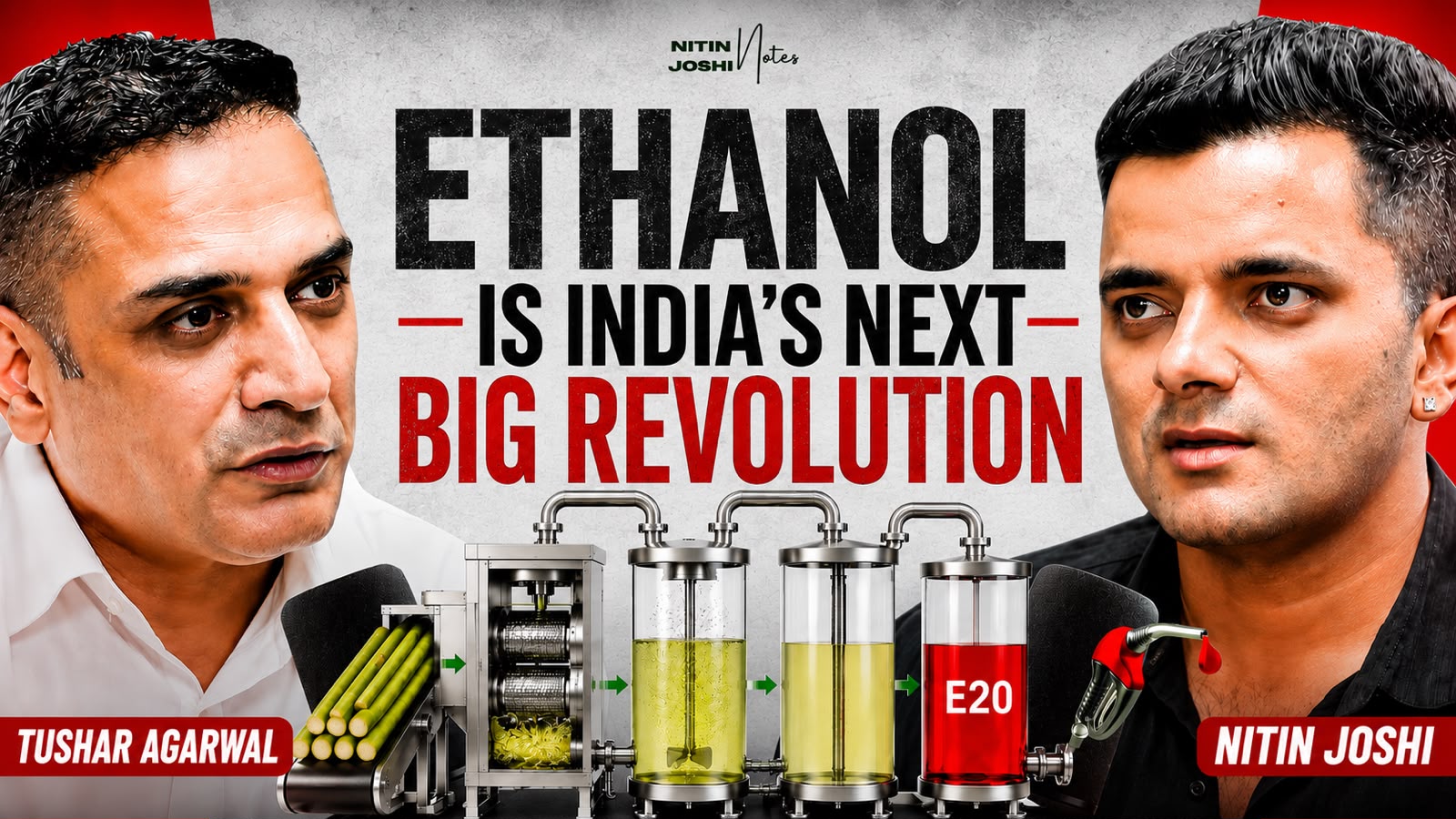
Industrialist outlines how ethanol can strengthen India’s energy security, empower farmers and reduce crude oil imports, while podcaster Nitin Joshi explores the opportunities and challenges behind the country’s biofuel mission.
As India accelerates its transition towards cleaner and more sustainable energy sources, ethanol has emerged as one of the country’s most ambitious policy initiatives. While discussions around E20 fuel have gained momentum across social media, a recent in-depth podcast featuring industrialist Tushar Agarwal and popular podcaster Nitin Joshi offered a broader perspective on why ethanol could become a cornerstone of India’s future energy economy.
The conversation went beyond the headlines surrounding ethanol-blended petrol and explored how the initiative connects agriculture, manufacturing, renewable energy, rural employment and national energy security. Throughout the podcast, Nitin Joshi raised several questions that consumers and automobile owners have been asking in recent months, while Agarwal explained why he believes ethanol should be viewed as a long-term national opportunity rather than simply another fuel.
A Conversation Focused on India’s Future
Beginning with the concerns that have dominated public discussion, Joshi questioned Agarwal on vehicle compatibility, fuel efficiency and the widespread misconceptions surrounding ethanol-blended petrol. Instead of dismissing these concerns, Agarwal acknowledged them and explained how the technology has evolved over the years.
According to Agarwal, India’s ethanol programme is part of a carefully planned strategy aimed at reducing dependence on imported crude oil while simultaneously creating new opportunities for farmers and entrepreneurs. He argued that the initiative should be viewed in the same light as earlier transitions to CNG, renewable power and electric mobility—technologies that initially faced scepticism before becoming widely accepted.
“Every new thing faces opposition,” Agarwal remarked during the discussion, adding that technological progress often takes time before gaining public confidence.
Beyond Fuel: Building an Entire Economic Ecosystem
One of the strongest messages to emerge from the podcast was Agarwal’s belief that ethanol is far more than a fuel additive. Describing it as an integrated economic ecosystem, he explained how ethanol production creates value across multiple sectors.
According to him, increased demand for maize (corn) has opened new income opportunities for farmers, while the production process also generates valuable by-products such as Distillers Dried Grains with Solubles (DDGS), a protein-rich cattle feed used by the dairy industry. Agricultural residues that once had little commercial value are now becoming part of a circular economy, creating additional income streams for rural communities.
Agarwal maintained that modern ethanol plants are designed to maximise efficiency through water recycling, zero-liquid discharge systems and the utilisation of biomass instead of conventional fossil fuels wherever possible. In his view, the industry represents a convergence of renewable energy, sustainable agriculture and rural industrialisation.
Farmers at the Heart of the Ethanol Mission
Throughout the conversation, Agarwal repeatedly emphasised that India’s farmers stand to gain significantly from the growth of the ethanol sector. He explained that greater demand for agricultural feedstock has created a stronger market for crops such as maize while also encouraging investment in rural infrastructure.
“The biggest beneficiary is the farmer,” he said, arguing that ethanol has the potential to improve farm incomes while reducing dependence on traditional agricultural markets.
He also explained how biomass utilisation and agricultural by-products are creating additional economic value instead of being discarded, contributing to a more sustainable agricultural ecosystem.
Reducing India’s Dependence on Imported Crude
A major theme of the discussion was India’s growing need to diversify its energy sources amid global geopolitical uncertainty. Agarwal argued that fluctuations in international crude oil prices continue to place significant pressure on India’s economy and foreign exchange reserves.
According to him, ethanol blending represents one of several important steps—including electric vehicles, compressed natural gas (CNG) and liquefied natural gas (LNG)—that can collectively reduce the country’s reliance on imported fossil fuels.
He also spoke about the future of flex-fuel vehicles, expressing confidence that automobiles capable of operating on higher ethanol blends, including E85, will become increasingly common in India over the next few years.
“The entire system can run on E85,” Agarwal said, describing flex-fuel technology as an important milestone in India’s long-term energy transition.
Nitin Joshi Calls for Independent Understanding
Rather than accepting every claim without scrutiny, Nitin Joshi approached the discussion from the perspective of an informed consumer. Throughout the podcast, he questioned Agarwal on issues that continue to concern vehicle owners, including engine compatibility, mileage and public perception.
As the discussion progressed, however, Joshi acknowledged that the conversation had introduced perspectives he had not previously explored in depth.
“I’ll study it from this perspective,” he said, adding that he intended to independently verify the information before reaching his own conclusions.
In one of the most engaging moments of the podcast, Agarwal invited Joshi to visit one of his ethanol manufacturing facilities and witness the production process firsthand. Joshi welcomed the invitation, expressing interest in understanding every stage of ethanol production before discussing the subject further with his audience.
Looking Beyond Today’s Debate
Towards the conclusion of the podcast, both speakers agreed that public awareness and informed discussion are essential as India advances its clean energy ambitions. Agarwal urged citizens to look beyond misinformation and evaluate ethanol through the lens of long-term national development, while Joshi emphasised the importance of verifying facts through firsthand observation and independent research.
The conversation ultimately reflected a larger national shift towards energy diversification and self-reliance. While discussions around ethanol are likely to continue, the podcast presented a comprehensive look at how the biofuel industry intersects with agriculture, manufacturing, sustainability and economic growth.
By bringing together the perspective of an industry leader and the questions being asked by millions of consumers, the discussion offered viewers a deeper understanding of one of India’s most significant energy transitions. As the country continues moving towards higher ethanol blending targets and cleaner fuel alternatives, conversations such as this are helping shape a more informed public dialogue around India’s journey towards energy security and sustainable development.
